
Willamette Valley Vole Summit 2025
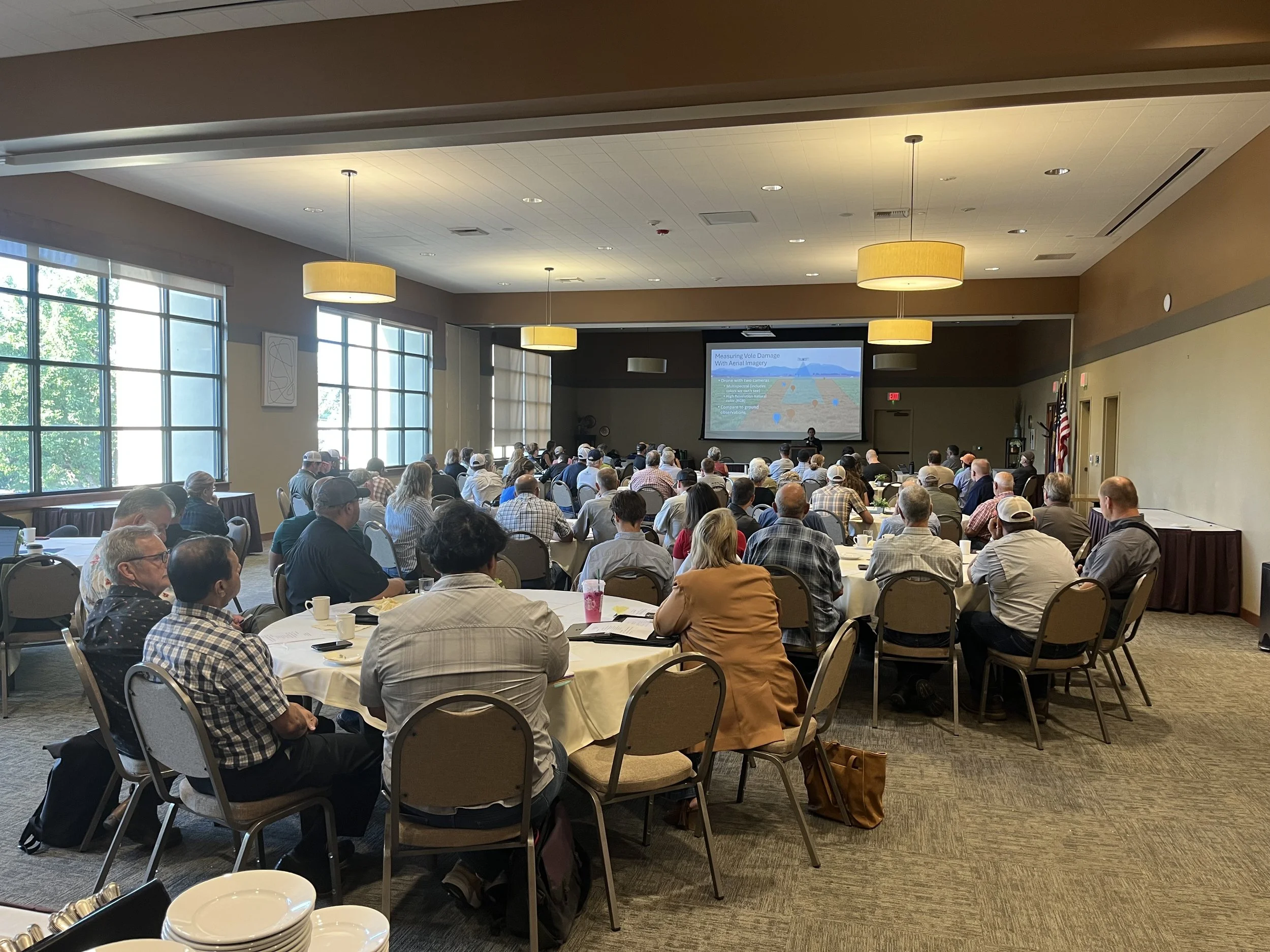
The Willamette vole summit brought together representatives from 12 different agricultural commodities, relevant state agencies including Oregon Department of Agriculture and Oregon Department of Fish and Wildlife, interested federal agencies including the USDA and USGS, a member of the Oregon House of Representatives, as well as academics, reseachers, and extension workers to co-develop strategies and solutions to vole management.
On August 29, 2025, the Oregon Grass Seed Commissions in partnership with the Willamette Vole Management group, USGS Oregon Cooperative Fish and Wildlife Research Unit, the Department of Fisheries, Wildlife, and Conservation Sciences at Oregon State University (OSU) and OSU Extension hosted a Vole Summit in Salem at the West Salem Roth’s Conference Center.
We had over 95 people attend the Willamette Vole Summit, with representatives from 12 agricultural commodities, state and federal agencies including ODA, ODFW, USGS, and USDA, as well as members of the legislature, and academics, researchers and extension workers. The purpose of this meeting was to bring together and engage all parties in Oregon that are being impacted by and/or involved in managing voles including growers and producers, industry stakeholders, state regulators, as well as academics and federal researchers.
The key objectives of the meeting were to review what research has been and is being done to inform vole management solutions and to co-develop research priorities that meet the needs of the people of Oregon. This meeting served to provide an agenda for the Willamette Vole Management Working Group.

The objectives of the Vole Summit 2025
In the morning the meeting started with a series of speed talks from various researchers working on voles in the Northwest including: 1) Dr Christy Tanner of Linn County Extension Office and Department of Crop and Soil Science at OSU speaking about her research using drones to monitor damage and vole populations, as well as her work testing new rodenticide possibilities within bait boxes. 2) Dr. Aaron Shiels with the USDA based at Fort Collins, Colorado who has been testing palatability of different bait options to try and increase uptake and efficiency of available zinc phosphide baits. 3) Dr. Dana Sanchez, a Wildife Extension Specialist with OSU who presented a summary of results from recent work trying to quantify various impacts of voles, as well as work from a few years on the efficacy of detection dogs in trap placement for voles. 4) Dr. Steve Sailsbury from the Oregon Seed Research Institute who presented his research on various possible deterents to reduce vole activity and impact. 5) Dr. Joshua P. Twining from the Department of Fisheries, Wildlife, and Conservation Sciences who spoke about the Willamette Vole Mangement working group, the establishment of long-term monitoring sites to characterize the interannual cycles of gray-tailed voles, and the construction of vole enclosures to facilitate research into efficacy of various control methods. 6). Matthew Bucy from the Oregon Department of Agriculture who spoke about regulations and availability of different rodenticides and process for getting new options registered for use in Oregon.
For the rest of the day the meeting involved a series of round tables where attendees were tasked with discussing and feeding back to the group on four questions:
1) What are the impacts of voles to you and your operation? (e.g., work, time, money, stress, livelihood, future, product quality, …)
2) What are we missing so far? What other ideas could we be considering?
3) What are the best ideas you’ve heard today?
4) What would you need to be able to implement these “best” ideas?
After each question, we fed back to the wider group, and collated ideas and discussion points from each of the tables to develop a broad understanding of responses to these questions among the assembled stakeholder groups. Take homes messages: from the round table discussions, it was evident that voles had major impacts in three domains: finances, time, and health and safety. Financial losses reported ranged from acres of vineyards to 50% yield from a single crop, while large time investments in attempting to control voles were widely reported. There emerged a consensus for research priorities focused on: 1) understanding vole ecology and cyclical dynamics, 2) exploring potential usefulness of reproductive disruption / immuno-contraceptives, 3) understanding the role of predators and effects of promoting wildlife habitat, and 4) improving available rodenticides. Participants identified a broad range of needs that would help facilitate the implementation of new solutions to vole management, including: funding for research and farmer implementation, published peer-reviewed science demonstrating efficacy of methods to help growers justify investments in methods and understand tradeoffs, and collaborative partnerships between growers, producers, researchers, and academics, as well as with regulators at state and federal agencies. This meeting provided clear guidance for research priorities and a mandate for the Willamette Vole Management Working Group moving forwards. For full report please see: https://www.oregonvoles.org/s/WillametteVoleSummitReport2025_updated.pdf
Keep your eyes peeled for the next vole meeting!
