
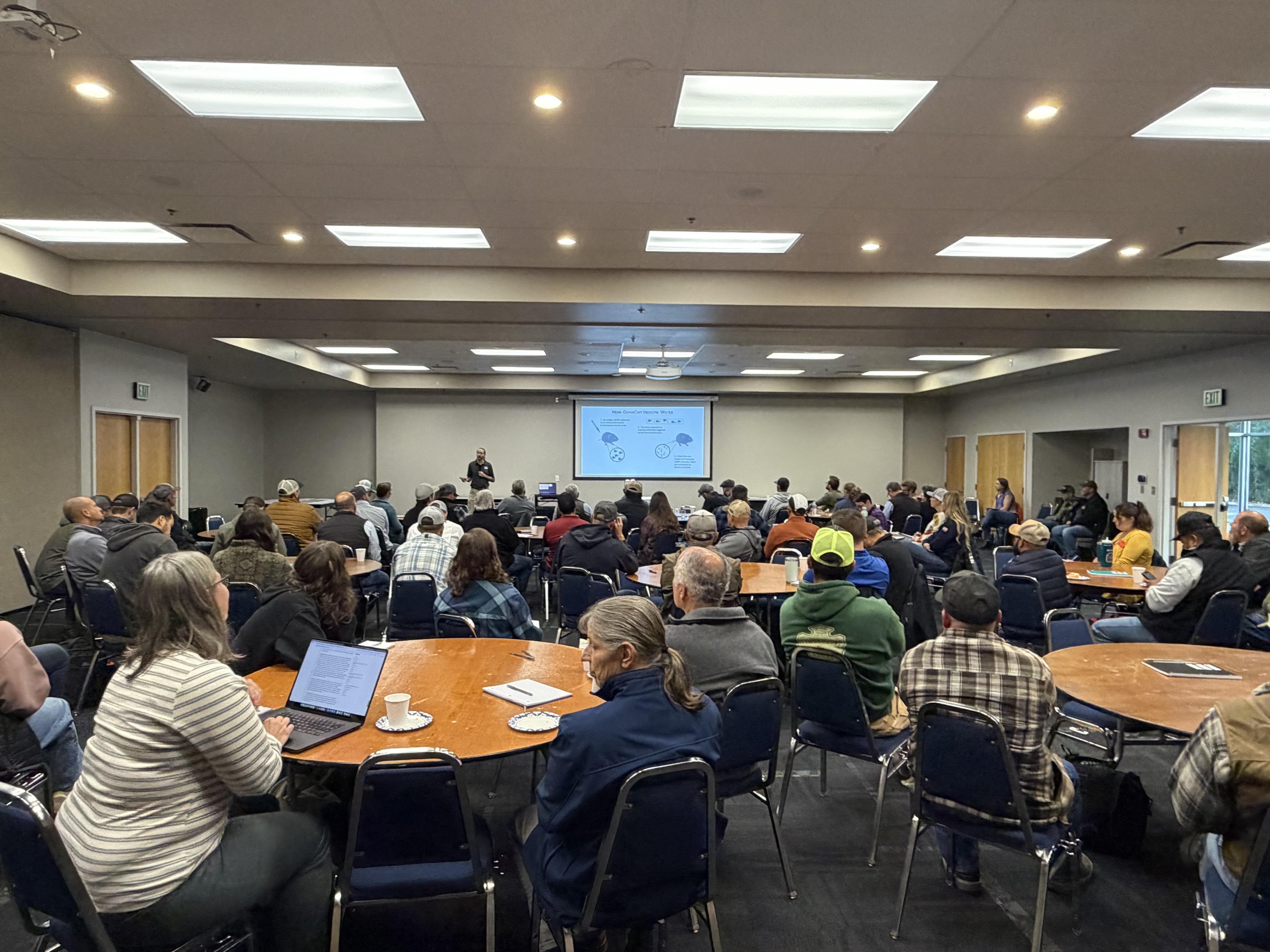
Growers, crop advisors, industry representatives and researchers met on Thursday, October 22, 2026, for the second annual Oregon Vole Summit, a little over a year after the first summit in August 2025.
Who was in the room
95 people registered. About half were farmers (50), joined by agronomists and crop consultants (18), people in other ag-industry roles (11), and research and extension staff (8).
Vineyards (45) and grass seed production (35) were the best-represented cropping systems, followed by hazelnuts (21), berries (16), small grains (14), forage (10), organic production (10) and vegetables (9). People could choose more than one.
What we did
The morning had three parts:
Research talks. Six updates from OSU, USDA and industry researchers on control tools, monitoring, disease and crop resistance.
Mapping. Attendees marked up to three of their fields on maps of the Valley and scored vole damage, season by season, for the last three years.
Ideas from the field. Three rounds of brainstorming on what growers have tried, what seems to limit damage, and what they would try with more resources.
Seven take-homes
1. There is no single fix. Every speaker pointed to combining tools: better baits, good timing, monitoring, and crop and habitat management.
2. Timing matters. Control works best when populations are low and before the grass is tall. Growers see voles move into unplowed fescue first, and shift with neighboring harvests and flooding.
3. Getting voles to eat the bait is the current bottleneck. Zinc phosphide pellets killed 75–100% of voles in cage trials, but results in the field are mixed. In cage trials with real foods, voles strongly preferred pear, apple, sweet potato, potato and carrot. These are next in line to be tested as zinc phosphide baits. Additives such as maltol and eugenol are also being explored, and maltol is showing promise.
4. Deterrents showed mixed results. Penergetic bzv cut vole activity for about a month in one tall fescue trial, but the effect had faded by spring and crop damage did not differ between plots. A second year of the trial is under way.
5. New arrivals, not deaths, appear to drive vole numbers. Densities ranged from 65 to 165 voles per hectare (26 to 67 per acre) at our long-term study sites. Survival stayed fairly constant, so the changes in density so far have come from changes in recruitment: young voles being born and new voles moving in. Marked voles stayed within about 10 m (33 ft) of the same spot for months, and radio-collared voles each used about 100 m², roughly 1/40 of an acre.
6. Protect yourself and your animals. About 30% of the gray-tailed voles tested carried Leptospira, and voles also carry Bartonella and Giardia. Wearing gloves, washing your hands, and vaccinating pets and livestock can help reduce the risk.
7. Your observations shape the research. The mapping data and field ideas feed directly into our forecasting models and the next round of trials.
Research lightning talk highlights
1. Fertility control and toxic baits
Aaron Shiels, USDA APHIS Wildlife Services, National Wildlife Research Center
Fertility control works, but probably not for voles in the field. The GonaCon vaccine cut juvenile numbers threefold in prairie dogs. For voles, trapping and injecting animals across large fields is too costly, and treated voles still feed on the crop.
Coatings did not make zinc phosphide pellets more lethal. Peanut-butter and cheese coatings gave the same 75–100% mortality in cage trials as uncoated pellets, across two bait brands. In a field trial, voles did favor coated baits when given a choice.
Anticoagulants performed well in the lab. Chlorophacinone (Rozol) and diphacinone (Ramik) killed 90–95% of voles in two-choice trials. The team hopes the data will support a Special Local Need registration with the Oregon Department of Agriculture for bait stations and burrow baiting. This registration is in review.
Fruit and vegetable baits are next. Across 24 cage trials and 13 field trials, voles chose pear, apple, sweet potato, potato and carrot most often. These will now be coated with zinc phosphide and tested.
Take-home: expect to combine techniques, and bait when populations are low and before the grass is tall.
2. Penergetic bzv as a vole deterrent
Steve Salisbury, Pacific Ag Resources
Design: a 1.4-acre stand of K31 tall fescue, treated plots versus untreated checks, with applications on November 11 and December 1, 2025, and March 9, 2026, with monthly scoring through May.
Result: in January, vole activity was lower in treated plots. There was no difference in other months, and crop damage did not differ significantly.
What changed: in treated plots, activity concentrated in small hotspots around burrows. This fits the product’s purported predator-stress effect.
Next: the trial continues for a second year. Open questions are how wide a border treatment needs to be, and whether a nearby trap crop would draw voles out faster.
3. Long-term population monitoring
Austin Nash, Department of Fisheries, Wildlife and Conservation Sciences, OSU
Why and how: to forecast outbreaks, the team is measuring what drives vole survival and breeding through monthly trapping on two grids, EEW and Baker’s Tract. So far: 6,000+ trap checks, 873 captures of 181 voles and 794 biological samples, with help from 14+ volunteer technicians.
Density: Baker’s Tract doubled from about 80 voles per hectare (32 per acre) in April to about 165 (67 per acre) in early August. EEW held at 65–80 per hectare through the summer, rising to about 87 in October.
Survival and breeding: 70–80% of voles survived or stayed from one month to the next; at EEW, females outlived males (about 80% versus 70%). New voles arrived in pulses throughout the year, with changes in density underpinned by changes in recruitment, with survival remaining relatively constant across sites and seasons so far.
Next: LiDAR vegetation mapping, camera traps for predators, and pathogen testing of the samples.
4. Maltol as a bait attractant, and radio-tracking voles
Josh Twining, Department of Fisheries, Wildlife and Conservation Sciences, OSU
Maltol is a natural compound from larch bark and pine needles that boosts bait uptake in closely related common voles.
Trial: a before-after control-impact design at two sites over six months, with maltol added to alternate trap rows. The trial covered 4,500 trap nights and 738 captures of 150 voles.
Result: capture rates rose by about 32% at one site and 10% at the other. This is a modest positive effect, with wide uncertainty; the attractive trap bedding and food may have masked part of it.
Radio-tracking (preliminary): ten adult voles carried tiny radio transmitters this fall. Resident voles used about 100 m² each, with no clear difference between males and females and no sign of territorial females.
Next: more collaring this winter, including a study of how infection changes vole behavior.
5. Vole diseases and your health
Brianna Beechler, DVM, PhD, OSU Carlson College of Veterinary Medicine
Leptospirosis: about 30% of 364 gray-tailed voles tested were positive (preliminary), among the highest of the Valley wildlife tested. It spreads through urine into water and soil and can infect livestock, dogs and people.
Bartonella: 8 of 17 voles were positive. It is spread by fleas.
Giardia: 6 of 31 voles from the Corvallis area were positive.
Risk rises with rainfall (leptospirosis), flea numbers (Bartonella) and high rodent density.
Take-home: risk reduction actions include wearing gloves when handling dead voles and washing your hands, vaccinating pets and livestock, keeping fleas off pets and out of the house, avoiding drinking untreated water, and talking to your doctor if you are concerned about exposure.
6. Breeding vole-resistant grasses and costing vole damage
Dustin Herb, USDA Agricultural Research Service
Standard damage scores: a consistent method for rating vole damage, including where it occurs and how fall and spring damage differ.
Economic impact: comparing seed yields in enclosures with and without voles over several seasons. The data could support crop insurance claims and grant funding.
Resistance screening: testing diverse grass germplasm for how much voles feed on it and how well it recovers. Low- and high-damage plants will be compared for carbohydrate content, water content and endophytes.
Breeding: crossing the best plants, retesting them in the vole enclosures, then releasing resistant germplasm to breeders and improved public varieties to growers.
Participatory mapping activity: voles across the Valley
The field cards from the mapping exercise are now being digitized and analyzed, and we will follow up with results in the near future.
Why we asked. One farm sees a field; a room full of farms sees the Valley. The OSU research team’s trapping sites alone cannot tell us whether outbreaks rise and fall together across the Valley, so your fields fill that gap. We want to answer three questions:
Do outbreaks rise and fall together in different parts of the Valley?
Which crops, tillage practices, locations and timings go with vole outbreaks?
Can we see outbreaks coming, and predict where and when to expect trouble?
What you gave us. Each participant marked up to three contrasting fields on a map panel. For each field, the card recorded crop, tillage, irrigation, valley floor or foothills, and a vole damage score for every season over the last three crop years.
What happens next. We will combine the cards into a larger-scale picture of vole damage over time. We were piloting this exercise, and your reflections on what worked and what was hard will shape how we run it next time, including a possible citizen science pilot program with growers.
Ideas from the field brainstorming activity
The brainstorming activity turned up a wide range of home-grown approaches and landscape patterns. They are anecdotal, but several are now on our list of things to explore in future.
1. What people tried this year
Penergetic bzv. Mixed: it worked in one place and not another. Voles seemed to cluster after the second application. One drone operator saw thermal hits disappear after treatment, with no rise in the neighboring field. Questions raised: Cost? How many applications a year? Preventive or curative? Would a border treatment stop new voles moving in? Is the post-application clustering a viable window for baiting?
Drone mapping. About 30 hours of color and thermal footage of vole colonies. Active burrows were GPS-pinned and re-flown to track movement, and a fall influx of new adults was observed. Questions raised: How far do voles move? How big an area do we need to treat?
Plaster of Paris bait. Voles ate seed and bait mixed with plaster, but numbers were too high to see a change in damage. Plastic tubes were used as bait stations. Questions raised: Do bait tubes need moving to reach voles from other areas?
Castor oil. Used by a nursery as a perimeter deterrent, mixed with water and dish soap; it may change behavior. Questions raised: Cost and labor.
Peppermint oil and scent bags. Little effect when sprayed on a field, because menthol disperses quickly. Works better in enclosed spaces such as engine cabs. Questions raised: Is it worth the expense?
Plant-based crops and repellents. Mint cover crops in vineyards (mowing releases menthol). Chicory was heavily infested, suggesting a trap crop. Alliums and meadowfoam were suggested as aversion crops. Eugenol has been tested on voles in Europe. Questions raised: Can trap or aversion crops pull voles away from the cash crop?
Burning sulfur. One grower reported success in winter. Note: not labeled for vole control.
2. What seems to drive damage across the landscape
Neighboring land: lawns and municipal areas act as reservoirs. Vole numbers rise when neighboring grass crops are harvested, suggesting movement between fields.
Water: flooding in the southern Willamette Valley pushes voles to higher ground. Burrows cluster along the tops of drain-tile lines, which are drier.
Cover crops: cover crops that go dormant early, especially in drought years, push voles onto grape vines, where they girdle them.
Tillage and burning: voles colonize unplowed fescue first. Plowing breaks up burrows, but the benefit may fade after about three years. Burning removes habitat and knocks populations down but does not eliminate them.
Livestock: pigs, cattle and sheep trample burrows; moving sheep through a field leaves dead voles in their wake.
Old burrows: voles move into abandoned gopher and ground-squirrel burrows.
Winter weather: mild, wet winters favor voles. The 2005 outbreak followed a mild winter with late rains and standing water, and cost about 50% of the tall fescue crop.
Crop stage: in tall fescue, voles now eat seed heads rather than whole plants. They nest above ground against the crown when vegetation is tall and burrow again after harvest. Damage comes from both feeding and nest-building.
Where the research program stands
Six years on from the 2019–20 outbreaks, the program has moved from setting up monitoring to running experiments.
2019–20: Major vole outbreaks. 10–30% of the grass seed crop was lost, an estimated $50 million or more.
2021–23: Growers go to Salem; OSU commits. $12.1 million from the legislature funds 31 new positions, including a wildlife ecologist.
2024: Wildlife ecologist hired.
2025: Vole research program launches. Long-term monitoring starts, the first four enclosures are built, and the first Vole Summit and working group meet.
2026: Scaling up. Population-cycle research and field trials expand, with eight enclosures and new collaborations.
2027: Experiments begin. Grass crops in all enclosures, citizen-based monitoring tools, and Vole Summit 2027.
2030: Long-term goals. Models that forecast when and where outbreaks occur, and a validated suite of control tools.
These long-term goals come from you. At the first summit, growers told us voles cost them money, time, and health and safety, and named four research priorities: vole ecology and population cycles, disrupting reproduction, predators and wildlife habitat, and better rodenticides.
What happens next
Mapping results. The field cards from the mapping exercise are being digitized and analyzed, and we will share what they show.
Field experiments. Grass crops will be established in all eight vole enclosures, and experiments will begin in 2027 alongside continued population monitoring.
Control trials. Zinc phosphide-coated fruit and vegetable baits, a second year of the Penergetic trial, and more maltol and radio-tracking work.
Citizen science. We will be demonstrating and developing monitoring tools you can use on your own farm.
Vole Summit 2027. We will be in touch with dates for fall 2027.
Stay involved
If you have tried something new against voles, or would like to host a monitoring site, please get in touch. Your input continues to guide the direction of this research.
Thank you
Thank you to the agricultural commissions that fund this work: the Oregon Grass Seed Commissions, the Oregon Clover Commission, the Oregon Blueberry Commission, the Oregon Processed Vegetable Commission, and OSU's Research Advancement Academy. Thank you also to our speakers, the growers who host our field sites, and everyone who came and shared their experience.
Full report from the first meeting can be found here
